Showing posts with label British politics. Show all posts

Thursday, 28 February 2013

The university is a factory - shut it down!


Our temporary occupation here should be considered a warning shot: this campus was always ours, and we will not allow management to terrorise our community any longer. 
We call on all staff and students to join us. To reclaim the spaces of our campus. To strike. To occupy.
The university is a factory – shut it down.

The introduction of £9,000 a year fees in English universities has inevitably forced the marketization of the educational establishments. They are, contrary to any sensible or moral approach to learning, now opportunities for profit. This is the goal, ultimately, of neo-liberalism; not only to chase 'growth' and profit to further than logically possible, but to undermine and crush any dissent towards it. Neo-liberalism is the fusion of a free market with a strong state - the latter allowing the former to flourish by force. 

Universities are cultural and social centres, as well as ones of learning. From the earliest years of education, schools and colleges also operate on this basis. This is further being undermined by the coalition government, as they push for on-line learning to disrupt student movements coalescing and growing on campus.

The recent occupations at Sussex University - one on-going, and two flash occupations - protesting at the privitisation of 235 jobs - those of cooks, cleaning staff, janitors - shows that the student movement is alive and well, despite the best attempts of the NUS to neuter it. Pictures from their Twitter account show speeches and marches to be well attended, and have already attracted the likes of Owen Jones, Laurie Penny, Caroline Lewis and Josie Long.

What is important about Occupy Sussex is that it shows that the student movement can surpass it's pre-occupation with the fees. The initial protests in London, and around the UK, were given a focal point by this, but they melted away when the cap was taken up. As the pillars and foundations of education are attacked, so must the student movement react and fight battles on all fronts. 

We can also see the rejection of the decay of university life in the growing actions of members of the Letters Of Public Terror group, who reacted to the stifling  anti-social aspects of their university and their management with a campaign of graffiti [PDF].

The rejection of neo-liberalism and marketization within universities, and within education wholesale, must be at the forefront of any struggle which aims to combat these destructive economic systems. Education establishes patterns followed throughout life - results in high school can dictate everything. Similarly, the indoctrination of life as a ruthless hunt for profit begins here. 

The university is a factory - shut it down!

Friday, 4 January 2013

How Labour have bought into Thatcher's hegemony


Classifying Thatcher’s hegemony


Stuart Hall’s The Neo-Liberal Revolution [PDF] is an analysis of the contrasting views and systems which have shared the popularity of the British public since 1945.

Firstly, the aftermath of the Second World War prompted an almost-unilateral level of support for the creation of a welfare state. It was the Labour party of Attlee that first pulled it together; but William Beveridge, upon whose famous report the welfare system was based, was a Liberal, and the plans even had support from the Conservative members of the wartime National Government. While Labour, at the time still a party which could claim to represent the working people of Britain, had made great gains in working class and poorer areas, it was not until the war that the wider population began to take notice of the situation of those in poverty around the country this happened when children from destitute inner-city areas were evacuated to the homes of wealthy country families. Although the level of camaraderie and collective British spirit at the time has been overplayed, this, perhaps, also had an effect. The desire for a cradle to grave support system was so deep that the Tory party were unable to win despite their entire campaign being based on the fact that ‘they’ had won the war with their candidate for PM Churchill.
It was not until 1979 that the idea of the welfare state was challenged, when Margaret Thatcher led the first of her three successive governments into an ‘ungovernable’ (as Ted Heath referred to Britain) maelstrom.
               
In 1979 Thatcherism launched its assault on society and the Keynesian state. But simultaneously it began a fundamental reconstruction of the socio-economic architecture with the first privatizations... Thatcherism thoroughly confused the left. Could it be not just another swing of the electoral pendulum but the start of a reconstruction of society along radically new, neoliberal lines? ...
[Thatcher] impelled people towards new, individualized, competitive solutions  'get on your bike', become self-employed or a share-holder, buy your council house, invest in the property owning democracy. She coined a homespun equivalent for the key neoliberal ideas behind the sea-change she was imposing on society; value for money, managing your own budget, fiscal restraint, the money supply and the virtues of competition. There was anger, protest, resistance - but also a surge of populist support for the ruthless exercise of strong leadership.
Hall is right to note the role of Thatcher as a strong leader in the eighties, which contributed hugely to her popularity. Unlike Heath, she did not appear to buckle under the pressure, did not resign Britain to being 'ungovernable'. At the end of eighties Thatcher and Thatcherism uncoupled, taking different trajectories. Thatcher was deposed by her own party in the wake of the poll tax riots, as they feared that she had pushed the people of Britain too far, and a decade of resentment had been building towards the party. John Major took over the party in 1990, and steered them back to the middle ground, reaching there before a Labour party which, under Neil Kinnock, had also moderated itself, largely by expelling the Trotksyist group Militant from its ranks. It was not until the re-branding of Labour under Tony Blair in the mid 1990s that they finally took back power.

This is where the political theory of Thatcherism returns - a Labour party willingly bereft of its social democracy, working class roots. As Hall notes:
But the 'middle ground', the pin-head on which all mainstream parties now compete to dance, became the privileged political destination. New Labour believed that the old route to government was permanently barred. It was converted, Damascus-like, to neoliberalism and the market.
Rather than attempt to reverse the destruction of industrial communities around the country, Labour simply forged on with the Thatcherite view that humans are inherently selfish. It catered overwhelmingly to the expanding middle class (which, in reality, was merely a brand of proletariat with a different quality of life and a collapsing class consciousness). Take, for example, the case of being able to buy your own council house. Remove the status symbol of a mortgage, and there is little difference between owning your own and continuing to rent. All you have done is contribute to the growth of a profit-driven market in housing, which, as a basic human need, should not be given over to the realm of private sector profit (as with health or education). New Labour persevered with this idea, as it believed that the free market could be used to lift people out of poverty - this runs parallel to the belief that working can lift you out of poverty, and is no less inaccurate.

One thing that Thatcher recognized about neoliberal economics, and capitalism in general, is that it must combine the opposed concepts of a free market with a strong state, in that the market must be protected so that it can flourish. Thatcher started the erosion of civil liberties in Britain, attempting to smash its enemies as much as possible. Her government used the police as a private army against striking miners, going out of their way to protect the police from any prosecution. It also eagerly took part in collusion with loyalist terrorist groups in Northern Ireland to murder civilians (when it wasn't just using the army to murder civilians, that is), and used a war over a tiny rock in the Atlantic Ocean to further the cause of British nationalism and imperialism into the twentieth century. This flexing of state muscles continued with Blair, who ignored the vast majority of people who opposed his illegal Middle East wars, and happily ignored the concept of human rights - be it against peaceful protesters, or terrorist suspects who were tortured. There was also nothing done to reverse laws which clamped down on trade union activity, giving Britain the staunched-policed workforce in Europe.

The Coalition government are happily advancing the free market/strong state idea (as they obviously would) but what is more worrying is the complicity of Ed Miliband and Ed Balls to conform to the neoliberal blueprint. Miliband has spoken of his admiration of Thatcher before, but the willingness to lazily conform to this hegemony is no more apparent in the case of the recent 'strivers' vs. 'shirkers' development.         

‘Strivers’ vs. ‘shirkers’

Classifying the people of Britain in two distinct camps was, in this case, Cameron's idea (he used the word skivers, but the intent was the same). Strivers are people who work hard, shirkers are people who attempt to avoid it.

It is, of course, a lazy, and horribly reductive. It is, politically speaking, a good move, as it means you do not have to stretch yourself attempting to appeal to more than one group - just set out two camps, and wait for the people to come to you. It does not look at the role played by people who are out of work, and want to be in employment, but cannot because there are not enough jobs being created. Or people who are in work, but skive their way through it. People who cannot work. The idle rich.

It is a classic, simplistic case of divide and rule, motivated by a series of lies and slanders aimed at the poorest people in society. And Labour have bought it.


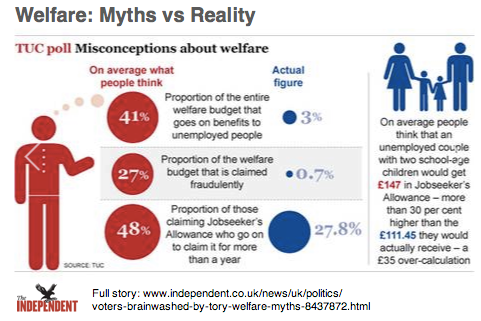
The Independent today has ran a front page story highlighting the truth behind the stats which roll from the tongues of Tory ministers who want to shame anyone on benefits - at the same time the Labour party have unveiled populist new plans to force anyone unemployed for over two years to take a job lasting six months, otherwise they lose their benefits. This again, is simplistic, ignoring the reality that there are not enough jobs being created, and playing into the idea that anyone unemployed for that length of time is simply 'idle'.

The complexities and failures of a jobs program by both main parties are for another blog post - what it serves as here is an example of the unwillingness of the Labour party to take the tough road (the 'old route' as Hall referred to it above) back to power. It has neglected its roots as a social democratic party for electoral reasons, which, at first, seem common sense. It was Thatcher herself that showed that hegemonies and established systems in Britain could be challenged, through her dismantling of the welfare state. Labour could channel the dissatisfaction with neoliberalism, and highlight its obvious failures. In this context, it would prove to be a greater opposition than it could ever be currently. There is a timidness in the way with which Labour approach politics these days - it no doubt fears electoral ineffectuality. On its current path, it is already ineffectual.        

Monday, 17 December 2012

Dreams of a united left


In Britain the political left is in a dire way. Save for rape-loving cod-socialist George Galloway smarming his way into the Commons through Bradford North, there is scarce representation across the country. So why, deep into yet another crisis of capitalism, is it this way? Why are the Labour party, dragged centre-right by Blair and Brown, refusing to budge from their new perch? Why, when radical left parties are on the rise in Europe, is Britain remaining fixated on neo-liberalism?

As Marx predicted, the internal contradictions of capitalism would inevitably lead to it self-combusting, not just once, but over and over again. As it has done, as it is currently doing. Greece,Spain, Portugal and Italy are all moving closer to complete collapse, and are in a much worse way to Northern European countries, but Britain is under the threat of a triple-dip recession, zero growth, jobs stagnation etc. – all the signs of economic failure. As a result of this the mistrust of the usual politics and politicians is growing, manifesting itself in a growth spurt for new protest party Ukip.

So where are the British left in all this? Absent, largely. Galloway’s Respect Party is the main force for the British left at the moment, gaining votes in traditionally Labour-dominated inner-cities. A smattering of various socialist and communist cliques can often be found propping up the running order of votes, defeating only the ‘Elvis Pensioner Party’ and the ‘9/11 Was An Inside Job’ candidate. It is strange, because in a time of such economic turmoil, the left should be finding its feet, offering, again, itself as a true alternative to the destruction of capitalism. 

More so, left wing parties offer a sane alternative to the even greater danger of fascist and far-right parties who aim to stoke a climate of fear around asylum seekers and outsiders, both as an outlet for the working class who are baring the brunt of austerity, and capitalism in general; and also, more simplistically, as a protest vote. 

One of the frequent criticisms of radical political movements is their inability to remain as a coherent group. There are schisms and rivalries inside the mainstream political parties, certainly, but it is rare that the tensions emerge as a definite split, and with such dogmatic factionalism, as fringe groups do (the same goes for the far-right as the far-left, as we have seen with the splintering of the BNP and the EDL). In Scotland the SSP was designed with the aim of bringing disparate left-wing groups together. It worked, briefly, until Tommy Sheridan split off to form Solidarity, bringing about the same weaknesses that had existed previously. The SSP’s vote sank from a high of six seats in a few years, and it remains mainly as a protest organising group with one councillor nationwide. Overcoming this factionalism and in-fighting is essential if the left are to regain their standing as a serious political group. It would prevent similar groups from taking votes from each other, and present a clearer alternative to mainstream politics for voters. Various political parties in Europe who have achieved much greater success than expected, such as Jean-Luc Melechon’s Left Front or SYRIZA inGreece, have operated as a rough coalition of parties and independents from across the left spectrum – eurocommunists to greens.

Pooling support and resources in this way is essential, but difficult. The aforementioned SSP/Solidarity split is a wound that is yet to heal. Groups like the SWP have gained a reputation as unlikeable cults, distrusted and mocked as much by the rest of the left as they are by the centre, if not more so.

Plus, looming on the horizon is a bigger problem for the radical left – the Labour party. The Labour party are no longer a left-wing party, no longer a party with the good of the working class at their heart. They are uncomfortable with trade unionism, uncomfortable with the risk of breaking with the Thatcherism, neo-liberal consensus which was established in the 1980s. But, because of the proud history of the party, and it’s undeniable left-wing roots, it continues to draw in well-meaning (but naïve) socialists and left-wingers, who believe that the party can change. The Labour party, as is, is a blockade to getter political representation for real left wing parties, draining voters and high profile supporters who would be better served by a united left front.

I am not naive. I do not believe this is an easy task, one which can be accomplished before the next election. It will take a lot of hard work, from all sides - some gritting of the teeth, some hiding (if not burying) of hatchets. It is also important to remember that politcal action is not, and cannot, be limited to the parliament. It needs to take place on the streets, in the forms of protests, strikes and occupations. It is socialism from the group up, discussing with people their desires and fears - not remaining aloof in a distant parliament, recording 60% attendence and fleecing the expenses system. If this happens, any left-wing politicans would be just as bad as the Labour party, or the Conservatives, or the Lib Dems. It is about making a radical change in the way politics is not only shared, but conducted. Parties are an open forum, and representation in power of the will of the people - could a left bloc be that?

Tuesday, 27 November 2012

The Polite British Far-Right

It's a tragic fact, that the mechanisms of capitalism swing every-closer to 'disaster' setting, political extremism on the right flares up. In Europe, which is straining most under the weight of the ongoing economic crisis, it has been the most noticable. Greece is the obvious example, where Golden Dawn, an openly violent facist party are currently polling third. In France, in Italy, all across Europe, the ugly head of facism rises, spouting Islamophobia.

What about in Britain? Our premier far-right party, the BNP, have disinegrated, but the individual splinters still protrude; the EDL, the British Freedom Party, the National Front - all offering a slight variation on the same old hatred (the EDL claims to be welcoming to non-whites and non-Christians, so if that ain't your thing, you might what to head by the openly white-supremacist NF).

If you look at the trends in the last few years, the rise of the extreme right-wing in Europe has been marked by parties that do embrace a form of facism, but in Britain, where, despite a flurry of electoral successes a few years ago for the BNP, they have made very little gain. Has the UK been spared, the trend passed it by? Not quite.


In Britain it's currently all about Ukip. They've been slowly building on successes in European and council elections, working towards calling themselves the new 'third party' in British politics, taking the place of the Lib Dems (this despite them never actually having won a seat in parliament - their only representation coming after a defection from the Tory party).

Ukip's rise in popularity has worried the Conservatives. They feared that Cameron was too close to the political middle ground to secure the traditional Tory voter base - he was, and many of them defected right to Ukip. In some places the popularity of Ukip has even been blamed for splitting the Tory vote, causing them to lose an estimated 40 seats at the last election. Michael Fabricant, who does something for the Tory party (he's high up, I don't care any more than that) has proposed an election pact between the two parties, as they increasingly seem like star-crossed lovers, split over a need to appeal to the centre vote.

The problem here is that Ukip represent the same ground as the BNP and their ilk - they just have a greater grasp of political PR. Ukip supporters and BNP supporters largely agree on the parties' main electoral points - immigration, British superiority, anti-Europeanism (unless they want to buy our stuff).

From the Guardian article 'Ukip shares more with the far right than it admits':

While they also appear deeply concerned about immigration and Islam, Ukip supporters are less intense and less hostile than their BNP rivals. They are also far more likely to consider violence as "never justifiable".
At the same time, however, Ukip critics tend to ignore the fact that their party does have considerable policy overlaps with the extreme right. Like the BNP, at the last general election Ukip demanded an end to uncontrolled immigration, tighter border controls, the expulsion of illegal immigrants, the removal of benefits for remaining immigrants and an "end the active promotion of the doctrine of multiculturalism by local and national government and all publicly funded bodies". This radical right pitch to voters included an end to political correctness and a ban on the burqa, and led Ukip to invite Geert Wilders to show an anti-Islam documentary in the House of Lords.
Ukip is not a rightwing extremist party, but on the doorsteps of voters it is often pushing the same message as the extreme right.
 What Ukip are able to do is exploit the British love for decent, honest 'chaps' who have little time for the political establishment (which Ukip claim to be outside, but are earnest supporters of). Their leader Nigel Farage smokes and is known to drink pints at lunch (probably British bitter). He is the walking embodiment of people who are just a little bit tired of political correctness and health and safety, and the liberals who push them on society.

Not mentioned in the article is Ukip's homophobic record - during the recent outcry in Rotherham, when the local council removed foster kids from the care of Ukip members because of the racist views of the party, Ukip were playing the victims. The actions of the council were perfect political fodder for the party, who used it to present a case of them being victimised and attacked by 'liberals' for their beliefs, in exactly the same way any far-right party would. (The BNP used to pull the 'they're trying to silence us because we know The Truth' card on several occasions.) What was hardly mentioned was the views of the Croydon North by-election candidate for Ukip, and the party's culture, media and sport spokesman, who said that it was wrong to allow gay couples to foster children. It was the usual stuff about the destruction of the 'traditional' Christian family, of course. Pinknews.co.uk has a further article it's worth reading about several other cases of homophobia in the party.

  Ukip supporters burn picture of openly-gay Lib Dem politican Brian Paddock
 
Listing the idiotic views of Ukip could be an enternal, Sysiphsian task. The crux of this article is this - Ukip differ from the BNP only in style and media presentation. They are slick, unencumbered by the Doc Martin-ed skinheads which are associated with other far-right movements. This makes them more dangerous. They are able to move, clandestine, into the wider political arena, trading on their created identity as a moderate party to come close to securing a place in government, as part of a Tory-Ukip coalition. They exist under the cloak that all 'protest vote' parties use - no one actually pays attention to their policies, they just want an alternative. An alternative Ukip certainly may be, but they are not even better than the Tories.