Showing posts with label neo-liberalism. Show all posts

Thursday, 28 February 2013

The university is a factory - shut it down!


Our temporary occupation here should be considered a warning shot: this campus was always ours, and we will not allow management to terrorise our community any longer. 
We call on all staff and students to join us. To reclaim the spaces of our campus. To strike. To occupy.
The university is a factory – shut it down.

The introduction of £9,000 a year fees in English universities has inevitably forced the marketization of the educational establishments. They are, contrary to any sensible or moral approach to learning, now opportunities for profit. This is the goal, ultimately, of neo-liberalism; not only to chase 'growth' and profit to further than logically possible, but to undermine and crush any dissent towards it. Neo-liberalism is the fusion of a free market with a strong state - the latter allowing the former to flourish by force. 

Universities are cultural and social centres, as well as ones of learning. From the earliest years of education, schools and colleges also operate on this basis. This is further being undermined by the coalition government, as they push for on-line learning to disrupt student movements coalescing and growing on campus.

The recent occupations at Sussex University - one on-going, and two flash occupations - protesting at the privitisation of 235 jobs - those of cooks, cleaning staff, janitors - shows that the student movement is alive and well, despite the best attempts of the NUS to neuter it. Pictures from their Twitter account show speeches and marches to be well attended, and have already attracted the likes of Owen Jones, Laurie Penny, Caroline Lewis and Josie Long.

What is important about Occupy Sussex is that it shows that the student movement can surpass it's pre-occupation with the fees. The initial protests in London, and around the UK, were given a focal point by this, but they melted away when the cap was taken up. As the pillars and foundations of education are attacked, so must the student movement react and fight battles on all fronts. 

We can also see the rejection of the decay of university life in the growing actions of members of the Letters Of Public Terror group, who reacted to the stifling  anti-social aspects of their university and their management with a campaign of graffiti [PDF].

The rejection of neo-liberalism and marketization within universities, and within education wholesale, must be at the forefront of any struggle which aims to combat these destructive economic systems. Education establishes patterns followed throughout life - results in high school can dictate everything. Similarly, the indoctrination of life as a ruthless hunt for profit begins here. 

The university is a factory - shut it down!

Friday, 4 January 2013

How Labour have bought into Thatcher's hegemony


Classifying Thatcher’s hegemony


Stuart Hall’s The Neo-Liberal Revolution [PDF] is an analysis of the contrasting views and systems which have shared the popularity of the British public since 1945.

Firstly, the aftermath of the Second World War prompted an almost-unilateral level of support for the creation of a welfare state. It was the Labour party of Attlee that first pulled it together; but William Beveridge, upon whose famous report the welfare system was based, was a Liberal, and the plans even had support from the Conservative members of the wartime National Government. While Labour, at the time still a party which could claim to represent the working people of Britain, had made great gains in working class and poorer areas, it was not until the war that the wider population began to take notice of the situation of those in poverty around the country this happened when children from destitute inner-city areas were evacuated to the homes of wealthy country families. Although the level of camaraderie and collective British spirit at the time has been overplayed, this, perhaps, also had an effect. The desire for a cradle to grave support system was so deep that the Tory party were unable to win despite their entire campaign being based on the fact that ‘they’ had won the war with their candidate for PM Churchill.
It was not until 1979 that the idea of the welfare state was challenged, when Margaret Thatcher led the first of her three successive governments into an ‘ungovernable’ (as Ted Heath referred to Britain) maelstrom.
               
In 1979 Thatcherism launched its assault on society and the Keynesian state. But simultaneously it began a fundamental reconstruction of the socio-economic architecture with the first privatizations... Thatcherism thoroughly confused the left. Could it be not just another swing of the electoral pendulum but the start of a reconstruction of society along radically new, neoliberal lines? ...
[Thatcher] impelled people towards new, individualized, competitive solutions  'get on your bike', become self-employed or a share-holder, buy your council house, invest in the property owning democracy. She coined a homespun equivalent for the key neoliberal ideas behind the sea-change she was imposing on society; value for money, managing your own budget, fiscal restraint, the money supply and the virtues of competition. There was anger, protest, resistance - but also a surge of populist support for the ruthless exercise of strong leadership.
Hall is right to note the role of Thatcher as a strong leader in the eighties, which contributed hugely to her popularity. Unlike Heath, she did not appear to buckle under the pressure, did not resign Britain to being 'ungovernable'. At the end of eighties Thatcher and Thatcherism uncoupled, taking different trajectories. Thatcher was deposed by her own party in the wake of the poll tax riots, as they feared that she had pushed the people of Britain too far, and a decade of resentment had been building towards the party. John Major took over the party in 1990, and steered them back to the middle ground, reaching there before a Labour party which, under Neil Kinnock, had also moderated itself, largely by expelling the Trotksyist group Militant from its ranks. It was not until the re-branding of Labour under Tony Blair in the mid 1990s that they finally took back power.

This is where the political theory of Thatcherism returns - a Labour party willingly bereft of its social democracy, working class roots. As Hall notes:
But the 'middle ground', the pin-head on which all mainstream parties now compete to dance, became the privileged political destination. New Labour believed that the old route to government was permanently barred. It was converted, Damascus-like, to neoliberalism and the market.
Rather than attempt to reverse the destruction of industrial communities around the country, Labour simply forged on with the Thatcherite view that humans are inherently selfish. It catered overwhelmingly to the expanding middle class (which, in reality, was merely a brand of proletariat with a different quality of life and a collapsing class consciousness). Take, for example, the case of being able to buy your own council house. Remove the status symbol of a mortgage, and there is little difference between owning your own and continuing to rent. All you have done is contribute to the growth of a profit-driven market in housing, which, as a basic human need, should not be given over to the realm of private sector profit (as with health or education). New Labour persevered with this idea, as it believed that the free market could be used to lift people out of poverty - this runs parallel to the belief that working can lift you out of poverty, and is no less inaccurate.

One thing that Thatcher recognized about neoliberal economics, and capitalism in general, is that it must combine the opposed concepts of a free market with a strong state, in that the market must be protected so that it can flourish. Thatcher started the erosion of civil liberties in Britain, attempting to smash its enemies as much as possible. Her government used the police as a private army against striking miners, going out of their way to protect the police from any prosecution. It also eagerly took part in collusion with loyalist terrorist groups in Northern Ireland to murder civilians (when it wasn't just using the army to murder civilians, that is), and used a war over a tiny rock in the Atlantic Ocean to further the cause of British nationalism and imperialism into the twentieth century. This flexing of state muscles continued with Blair, who ignored the vast majority of people who opposed his illegal Middle East wars, and happily ignored the concept of human rights - be it against peaceful protesters, or terrorist suspects who were tortured. There was also nothing done to reverse laws which clamped down on trade union activity, giving Britain the staunched-policed workforce in Europe.

The Coalition government are happily advancing the free market/strong state idea (as they obviously would) but what is more worrying is the complicity of Ed Miliband and Ed Balls to conform to the neoliberal blueprint. Miliband has spoken of his admiration of Thatcher before, but the willingness to lazily conform to this hegemony is no more apparent in the case of the recent 'strivers' vs. 'shirkers' development.         

‘Strivers’ vs. ‘shirkers’

Classifying the people of Britain in two distinct camps was, in this case, Cameron's idea (he used the word skivers, but the intent was the same). Strivers are people who work hard, shirkers are people who attempt to avoid it.

It is, of course, a lazy, and horribly reductive. It is, politically speaking, a good move, as it means you do not have to stretch yourself attempting to appeal to more than one group - just set out two camps, and wait for the people to come to you. It does not look at the role played by people who are out of work, and want to be in employment, but cannot because there are not enough jobs being created. Or people who are in work, but skive their way through it. People who cannot work. The idle rich.

It is a classic, simplistic case of divide and rule, motivated by a series of lies and slanders aimed at the poorest people in society. And Labour have bought it.


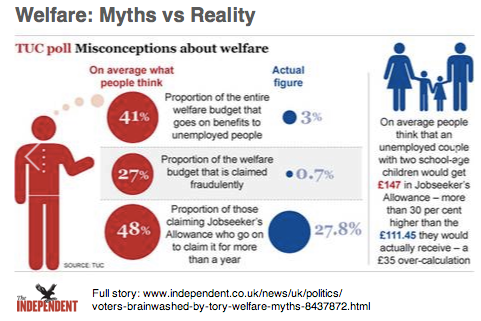
The Independent today has ran a front page story highlighting the truth behind the stats which roll from the tongues of Tory ministers who want to shame anyone on benefits - at the same time the Labour party have unveiled populist new plans to force anyone unemployed for over two years to take a job lasting six months, otherwise they lose their benefits. This again, is simplistic, ignoring the reality that there are not enough jobs being created, and playing into the idea that anyone unemployed for that length of time is simply 'idle'.

The complexities and failures of a jobs program by both main parties are for another blog post - what it serves as here is an example of the unwillingness of the Labour party to take the tough road (the 'old route' as Hall referred to it above) back to power. It has neglected its roots as a social democratic party for electoral reasons, which, at first, seem common sense. It was Thatcher herself that showed that hegemonies and established systems in Britain could be challenged, through her dismantling of the welfare state. Labour could channel the dissatisfaction with neoliberalism, and highlight its obvious failures. In this context, it would prove to be a greater opposition than it could ever be currently. There is a timidness in the way with which Labour approach politics these days - it no doubt fears electoral ineffectuality. On its current path, it is already ineffectual.        

Wednesday, 14 November 2012

United Europe: Can #14N be the start of something bigger?

Today is a European-wide day of action against austerity. Trade unions across the continent have called strikes and protests against the actions which have been replicated, to varying degrees, by every government in the EU - actions which pointlessly pump blood into the hemorrhaging veins of the neo-liberal economy. The levels of disruption varies by country - for the most part, it is the southern states which have taken part the most, with general strikes called in Spain, Portugal, Greece, Italy, Cyprus and Malta.


The actions follow, for some countries (Greece especially) several years of strikes and protests, each challenging the government spending cuts which were all meant to be the last. The message has been, and will continue to be - the people can take no more. And yet, the governments of Europe do not listen, further pulling their economies down into the abyss. Measly job growth figures for Britain, no matter what the coalition government say, cannot hide this fact. Much of the work created is part-time, in an economy geared towards full-time employment (for full-time consuming). We are set, one day, to join Greece and Spain, and Portugal and Italy, and France and Germany, staring to the abyss. With those 700 million European people there, it might actually be a bit cosy.

Britain sees itself as a European rebel, not even really part of the continent. Physically and mentally it sits aloof, an outcast. There is a seam of anti-Europe sentiment in Britain, stereotypically mined by the political right. Far right parties like the BNP push this agenda, but in the mainstream it is carried by the right-wing of the Tory party (which always finds itself at odds with the less-right-wing faction, a rift which threatens to rupture every few years), and, increasingly, Ukip, which has always done well in the European elections (although less so in strictly domestic polling). The standard is: to oppose Europe is right-wing, to welcome Europe is left-wing.

Europe, in this case, does not particuarlly refer to the continent itself, or the countries which comprise it, but the European Union, and the various facets and organisations through which it governs. In this case, is there any reason for the left to support 'Europe'? Owen Jones recently wrote an article lamenting the tendency of the British left to blindly support Europe and the EU, which, as he says, is 'an institution which both threatens democracy and the interests of working people'.

Democratically, the EU is indeed a worrying sight - it is controlled largely by the Council of Ministers, which is undemocractically elected, being picked by the governments of each country rather than by the European people themselves. European interegration also means submitting to the will of the European Central Bank, which 'obsess[es] over inflation while parts of Europe crumble'. Jones also points out various measures which, if implimented, would make the lives of working people in Britain better - the nationalization of the train network, and the introduction of a living wage - which are blocked by a European Union driven only by free trade and privatisation.

In short, the EU has been a sustained attack on both liberty and workers rights, and yet the left sit on their hands, uninterested in trying anything to change this. People across Europe are unhappy with the current functioning of the EU, but they are not far-right xenophobes who don't own passports and are suspicious of all other cultures. European interegration as a concept is not the problem, merely the current method of it. Mainstream centre-left parties across Europe need to wake up to this realisation, and face down the right-wing who do oppose Europe on paranoid xenophobic grounds.

As these parties are, by definition of being mainstream political parties, vote chasers, it must be the people of Europe which drive this change in the anti-EU discourse. Days of continental solidarity like #N14 are examples of this. The general strikes in the south have been complimented by solidarty meetings and protests across Europe, in places too innumerable to mention. Like the Occupy movement, they share a common, international bond while retaining a focus on local matters. They oppose neo-liberalism austerity in whatever shape it appears to them. The Glasgow march, for example, while titled 'From Scotland To Greece: No Justice, No Peace!' and designed solely as a solidarity meeting was altered to focus on the recently-announced privitisation of George Square.

The European Trade Union Confedertation, which called todays day of action, must push for further integration with unions across Europe. Most of the time when general strikes are called in each country the unions go out on their own. No longer - further solidarity must be shown. The concept of a strike is simple - when the workers stand together, they can win. When scabs begin to drift back to work, the strike is weakened, perhaps not in numbers but in spirit. The site of an open workplace is demoralising to a picket line, essentially a failed task in this case, is hovering about outside.

If Europe is really to be 'shut-down', as some blogs claimed it was, then a greater cohesion of the worker's unions must be achieved. A 24- hour general European strike, comprising of all public and private sectors unions from all countries, would be a start. It would do two things - firstly, reclaim the anti-EU dialogue from the political right, who are currently using it to channel their own jingoistic views.


Secondly, stop the ability of the EU and the ruling class to divide us - "it's the Greeks! They only work for about three hours a day over there! And they retire at fifty!", showing the true nature of an integrated Europe which the EU promises, but could never provide. An EU for the people of each and every country, united against greed, profit and neo-liberalism.